
Test.
30 minutes online.
I use FirstMind Talent Discovery test. It takes 30 minutes online and measures 34 talents. Your results are explained in clear language, with training in using them actively.
A type-based test divides people into a few categories. The 34 talents can be arranged in 2.95 × 1038 different orders. That is far more than the number of people on Earth. It allows the test to show the individual, not just a type.
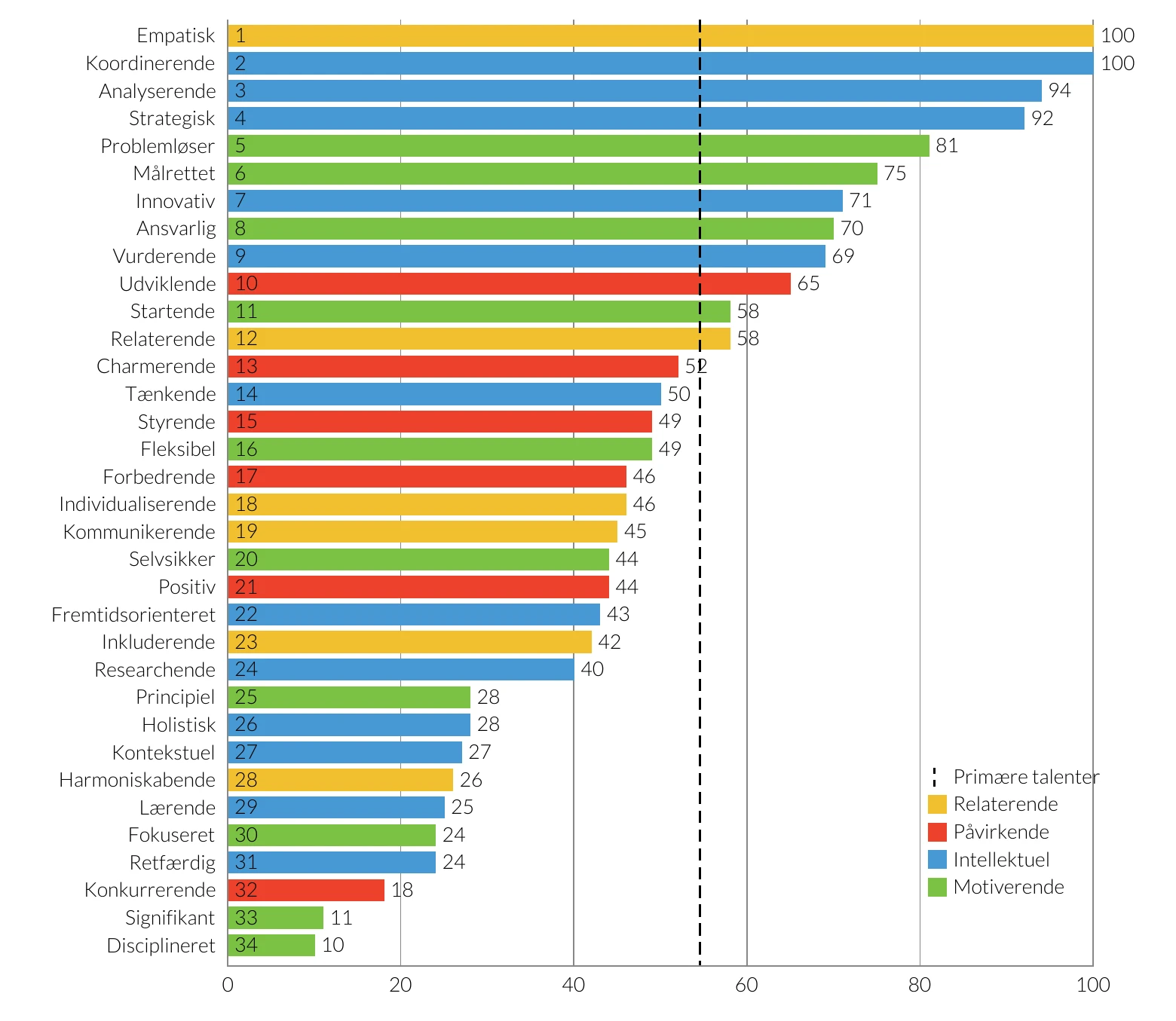
The profile shows all 34 talents in order, from the talent the person uses most to the one they use least. Talents whose bars extend beyond the dashed line are the primary ones: those that come most naturally. The colours show the four groups the talents belong to. It is the combination that makes the profile unique.
Validated. FirstMind Talent Discovery test is validated in the same way as TT38.
Built on research. Gallup's meta-analysis of 43 studies involving 1.2 million employees found that strengths-based development is associated with 14–29% higher profit, 9–15% higher employee engagement and 3–7% higher customer engagement (Asplund, Harter, Agrawal & Plowman, 2016). The study used Gallup's own test. FirstMind is based on the same understanding of talents.
Difficult to game. The talent test uses paired choices: you choose between two statements. This format makes it harder to embellish answers than in ordinary questionnaires (Cao & Drasgow, 2019).
Robust measurement. The test has 440 questions. Each choice has a time limit, so you answer before overthinking, and each talent is measured with more than 12 questions, so no individual answer determines the result.
Built on personality research. The test's talents are linked to the five-factor model. It is the most extensively studied model in personality psychology (Costa & McCrae, 1992).
Every response is checked. The report ends with a test validation covering four checks: whether all questions have been answered, whether the control questions have been answered consistently, the time taken and the distribution of answers. The report states whether the response is valid.
What the test cannot do. The test is a development tool and does not provide a diagnosis. The stress graph does not show whether a person is stressed. It shows how stress is expressed in the person's behaviour and how prone they are to becoming stressed.
30 minutes online.
I interpret your 34 talents in relation to the situations you face. When you test your employees, both the manager and the employee see the results.
My training method shows where your pattern takes over and where you can choose.
See the model“Throughout my working life I have been assessed using a number of the best-known assessment tools. Unfortunately, the feedback in connection with these assessments has been lacking. […] That is not at all the case with Bonnie.”Chief Government Relations Officer, DAMMO
“[…] I had not expected the test to be very different from similar assessments I had taken before – such as the DISC assessment. What set this assessment apart from the others was Bonnie's thorough explanation of the results.”Client adviser and project manager, Syddjurs Municipality
“[…] With her professional approach and empathetic nature, she supports the process by thoroughly reviewing key considerations, which helped me make a well-informed and confident choice. I ended up hiring a candidate whom I felt would thrive in the role and whom we would be happy to have.”Head of IT Portfolio, BoConcept